
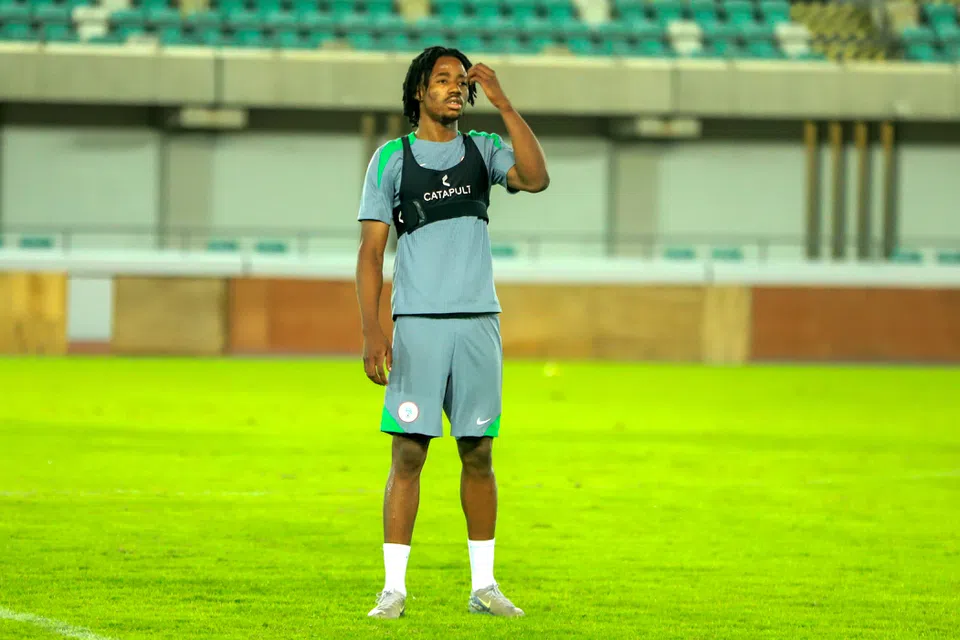
AFCON 2025 preparations and squad announcements have moved into a gripping new phase, with Nigeria celebrating key returns just as Cameroon spring one of the most dramatic selection calls in recent tournament memory. Between the Super Eagles’ defensive reshuffle and the Indomitable Lions’ headline omissions, Morocco is set to welcome a continental showpiece charged with storyline and emotion.
Nigeria’s mixed week of pain and possibility
Nigeria’s build up took a heavy blow with the injury to Benjamin Fredrick, the Brentford centre back on loan at Dender who had started the Super Eagles’ last six matches. His training ground setback rules him out until after the finals, a development that removes a versatile pillar who could operate at centre back, right back, or as a defensive midfielder.
Yet out of that disappointment came a vital boost. Slavia Prague defender Igoh Ogbu returned to action after 91 days out with a hamstring issue, coming on for the final 19 minutes in a 3-0 win over Slovacko. For coach Eric Chelle, the timing could not be better as he looks for stability at the back with less than a month to go before the tournament in Morocco.
Why Ogbu’s return matters for the Super Eagles
Ogbu last appeared for Nigeria in June during a friendly against Russia, and his absence was felt in a depth chart suddenly stretched by injury and form. He may not mirror Fredrick’s range of positions, but he brings experience, physicality, and leadership into a unit that needs clarity and calm. The centre back’s availability increases competition and offers tactical cover as Nigeria recalibrate their defensive structure.
Fredrick’s rise had been rapid, underlined by a standout World Cup qualifying performance against Gabon where he shackled forwards like Pierre-Emerick Aubameyang and Denis Bouanga. Even captain William Troost-Ekong hailed him as “the future” of Nigeria’s defence, praise that underscores the size of the gap left behind and the urgency behind Ogbu’s reintegration.
Fisayo Dele-Bashiru adds spark to the midfield
There is another significant piece of good news from Europe. Lazio midfielder Fisayo Dele-Bashiru made his first appearance since September, stepping off the bench against AC Milan and completing 28 controlled minutes at an impressive 92 percent pass completion. For Chelle, this is an overdue injection of tempo and thrust in a midfield that has lacked depth and two-way dynamism.
Dele-Bashiru’s last notable involvement for the Super Eagles had left a strong impression, particularly around the South Africa fixture in Uyo, and his recovery has been carefully managed by Lazio’s medical team. The timing of his return offers Chelle options between creativity and power, a combination Nigeria have craved in tight matches.
Fans push for a wild card in attack
Supporters are also amplifying calls for a fresh attacking edge, with Millwall’s Femi Azeez emerging as a social media sensation. The 24-year-old, born to a Nigerian father and Spanish mother, unleashed a viral left-footed strike in a Championship win over Southampton, bringing his season tally to six goals along with one assist and keeping the Lions high in the promotion race.
Azeez leveled in the 72nd minute after linking with Tristan Crama, then Millwall surged to victory through a Caleb Taylor screamer and a Crama stoppage-time winner. His earlier strike against West Brom, nominated for the October 2025 Goal of the Month, also showcased his ability to create something from distance. For a Super Eagles attack seeking variety, his pace and precision offer a tantalising alternative.
“Femi Azeez!!!!!!!! Mad left foot.”
That was one of many ecstatic reactions as fans clamored for Chelle to consider a late inclusion. Others went further, suggesting Azeez could push established names and add a decisive weapon for Morocco. Whether a call up materializes or not, the groundswell reflects a national appetite for a different angle in the final third.
Cameroon rip up the script with a sweeping reset
While Nigeria piece together solutions, Cameroon have opted for revolution. First-choice goalkeeper Andre Onana, on loan at Trabzonspor from Manchester United, has been dropped from the Indomitable Lions’ AFCON squad. The decision arrives despite his solid international numbers, eight clean sheets in 15 Cameroon appearances, and comes shortly after a World Cup qualifying playoff defeat to Gabon where Onana had remained the starter.
The shake up extends beyond personnel. Belgian coach Marc Brys has been removed, with domestic coach David Pagou appointed and set to be assisted by Martin Ntoungou Mpile, according to Reuters. FECAFOOT president Samuel Eto’o, re-elected last week, has moved decisively after the failure to qualify for the 2026 World Cup.
Onana and Aboubakar among the headline omissions
Onana’s club trajectory has been under intense scrutiny after a troubled spell at Manchester United led to his temporary move to Turkey. Yet, his international form had remained strong, making the omission a jarring marker of the federation’s new direction. AFCON 2021 Golden Boot winner Vincent Aboubakar is another high-profile absentee, a sign that no status is beyond review as Cameroon press reset.
In squad terms, Eto’o and Pagou have signaled a commitment to fresh combinations. The 26 names mix Europe’s top leagues with domestic and emerging profiles, hinting at a team built on balance rather than star aura. The goalkeeping group features Devis Epassy, Simon Omossola, Simon Ngapandouetnbu, and Edouard Sombang.
Cameroon squad in full
Goalkeepers: Devis Epassy, Simon Omossola, Simon Ngapandouetnbu, Edouard Sombang.
Defenders: Samuel Kotto, Gerzino Nyamsi, Jean-Charles Castelletto, Nouhou Tolo, Flavien Enzo Boyomo, Mahamadou Nagida, Christopher Wooh, Junior Tchamadeu, Darlin Yongwa.
Midfielders: Martin Ndzie, Carlos Baleba, Arthur Avom, Eric-Junior Dina Ebimbe, Brice Ambina, Jean Junior Onana, Olivier Kemen.
Forwards: Bryan Mbeumo, Christian Bassogog, George-Kevin N’Koudou, Danny Namaso, Frank Magri, Karl Etta Eyong, Christian Kofane, Patrick Soko.
Tactical ripples and what it means for AFCON 2025
For Nigeria, Ogbu’s return creates a clearer path to a more settled back line. The absence of Fredrick erases a unique Swiss army knife profile, but Ogbu’s organisation and physical duel strength can steady the unit around specialist roles. With Dele-Bashiru fit again, Chelle has the option to connect defence to attack through a midfielder who can carry, combine, and create under pressure.
In attack, the debate around Azeez captures a familiar pre-tournament tension between form and familiarity. A late pick would mean threading a newcomer into established patterns with limited time, yet the Super Eagles have benefited before from the audacity to trust a hot hand. The coaching staff must weigh competition level, chemistry, and the balance between wide pace and interior playmaking.
For Cameroon, the implications are even more dramatic. Dropping a goalkeeper of Onana’s pedigree shifts technical responsibilities in possession and alters the leadership profile at the back. The choice also reorients the dressing room dynamic around Pagou, who inherits not just a squad, but a statement of intent from the federation that recent standards are not acceptable.
Up front, moving on without Aboubakar asks others to claim the penalty area and the pressure moments. Bryan Mbeumo headlines a forward group that can stretch teams and attack space, while wide threats like Christian Bassogog and George-Kevin N’Koudou carry familiarity at international level. The midfield mix, with Carlos Baleba and Eric-Junior Dina Ebimbe among the options, suggests a desire for mobility and athletic control in central spaces.
The human stories behind the headlines
International football often swings on small margins, and these squads reflect that human reality. Fredrick’s surge to prominence, endorsed by Troost-Ekong as “the future,” meets the cruel timing of injury. Ogbu’s steady, diligent recovery offers a reminder that resilience is as much a tool as talent, especially in a position defined by trust and organisation.
Dele-Bashiru’s 92 percent pass completion on return may read like a number, but for a player working back from months on the sidelines, it speaks to concentration, rhythm, and the confidence to take the ball again. For fans invoking Azeez after a thunderous goal, the message is simple, pick the brave legs that can change a game in one swing.
Across the border, Cameroon’s reset is not just bureaucracy, it is identity. Eto’o’s push for change after World Cup qualification failure asks a proud football nation to accept discomfort today for a sharper tomorrow. In that context, leaving out Onana and Aboubakar is not merely selection, it is a cultural call for renewed hunger and accountability.
Pagou and assistant Martin Ntoungou Mpile, as cited by Reuters, inherit a group with enough talent to make noise in Morocco. The question is how quickly they can imprint clarity without the familiar voices that once carried the dressing room. The answer will arrive in how the new spine communicates, competes, and copes when the first big save or first big chance must be taken.
Key takeaways as Morocco beckons
- Nigeria gain defensive cover with Igoh Ogbu back fit,
- midfield control improves with Fisayo Dele-Bashiru’s timely return,
- fan-fueled momentum surrounds Femi Azeez as a potential attacking wildcard.
- Cameroon drop Andre Onana despite strong national team numbers,
- Vincent Aboubakar misses out as a new leadership core emerges,
- David Pagou takes charge with Martin Ntoungou Mpile assisting, according to Reuters.
What to watch next
For the Super Eagles, monitoring Ogbu’s minutes and sharpness at Slavia Prague will be crucial, as will Dele-Bashiru’s continued integration at Lazio. Any late decision around Azeez would hinge on medical assessments, tactical fit, and the appetite for a late curveball, all under Chelle’s watch as the final list is confirmed.
For Cameroon, early training camp signals will matter, from goalkeeper hierarchy to how the midfield balances ball progression and defensive coverage. Without Onana and Aboubakar, the onus falls on new voices to marshal pressure moments and on the collective to embrace a different personality for a different challenge.
AFCON is often at its best when powered by renewed belief, and that is exactly what this week has served. Nigeria, battered by injury, still find room for optimism in returning legs and rising noise. Cameroon, stung by recent disappointments, choose a harder path in search of a higher ceiling. Between calculated risk and timely recovery, Morocco now waits, and with it the test that turns all these December headlines into January truth.