
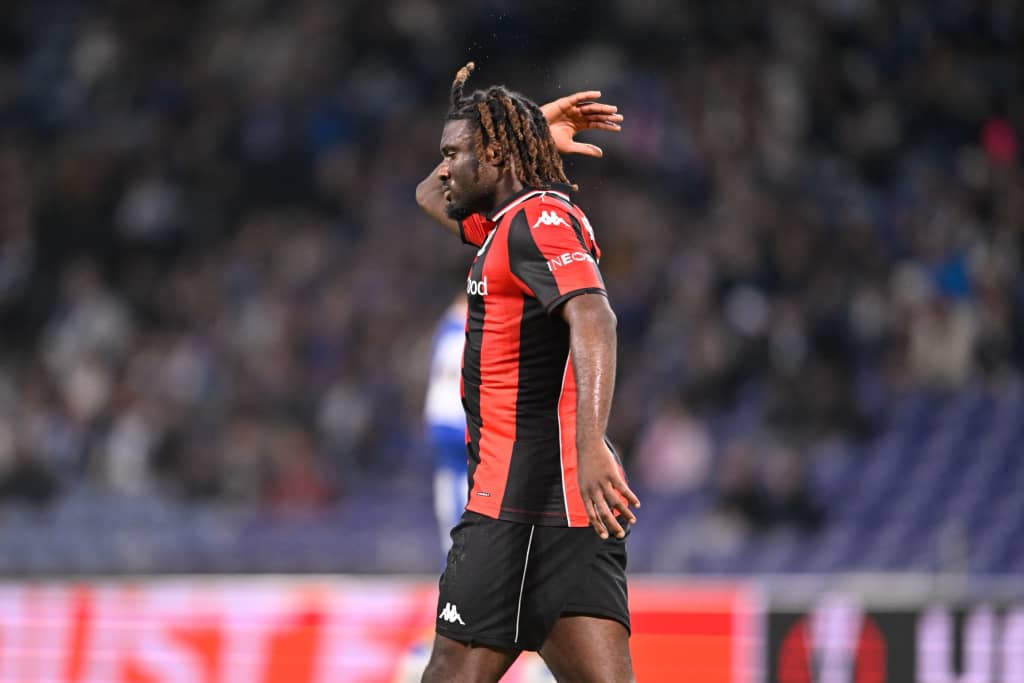
The shock and scale of the Super Eagles and Ligue 1 Incident have pushed French football into a moment of reckoning. In the space of a few angry minutes, a returning team bus became the flashpoint for a crisis that now threatens to reshape OGC Nice, and to test how the game protects those who give it life on the pitch.
This was not a routine confrontation between supporters and a struggling side, it was a violent escalation that left Terem Moffi and Jérémie Boga shaken, bruised, and on medical leave. It was also a tableau of the modern game’s fault lines, where passion can turn toxic and where safety, dignity, and the right to work without fear must be defended.
What happened at the Nice training ground
After a 3-1 defeat at Lorient, the seventh loss of a faltering campaign cited in one report and the sixth straight in all competitions in another, roughly 400 supporters gathered at OGC Nice’s training center and waited for the team bus. According to reporting referenced in multiple outlets, the scene turned violent as at least one fan boarded the coach and players were forced off into a crowd that was in no mood to forgive or forget.
Witness accounts described how Moffi and Boga were singled out, spat on, slapped, and kicked, with blows to the torso and groin. Sporting director Florian Maurice was also pushed and struck while being escorted away. Some players endured racist insults, a line that no rivalry or frustration can ever justify.
The disturbing images behind the headlines
One detail cuts through the noise. In the aftermath of the assault, Moffi needed help just to reach safety, and goalkeeper Yéhvann Diouf stepped in to escort him through the chaos and into the club’s building. That small act of protection, reported from inside the club, is a reminder that behind every badge and every scoreline there are people coping with fear and shock.
Sources within the club told reporters that Moffi was visibly shaken. He was granted a temporary leave of absence, not only to tend to any physical pain, but also to recover mentally from an experience that no professional should face. Player safety is not a slogan, it is a duty, and it was broken on that night.
Why Moffi and Boga were targeted
Reports offered context for the hostility. Moffi had been seen laughing with Lorient president Loïc Fery on Ligue 1 Plus after the loss, an image that angered some supporters. Boga, for his part, had invited Marseille fans to the Allianz Riviera the previous weekend, an act he later apologized for. These are talking points in any supporter culture, but they were seized upon as pretexts for a shameful turn to violence.
According to RMC Sport, both players are on sick leave, with Moffi ruled out until Sunday and Boga for five days. L’Équipe reported that each has filed a legal complaint, and several outlets indicate that neither player intends to represent the club again, with both now actively seeking exits. That is not a transfer rumor, it is the human response of two professionals who no longer feel safe at work.
Nice condemn the attacks and promise support
OGC Nice issued a firm statement confirming that players were attacked and placed on leave, condemning the violence and pledging support to the victims. The language was unambiguous, and it acknowledged both supporter frustration and the absolute red line that was crossed.
On Sunday, on their return from Lorient, the Eaglets were welcomed at the training ground by an important gathering. The club understands the frustration created by the succession of poor displays and performances far from its values.
However, the excesses we saw during this gathering are unacceptable. A few members of the club have been attacked. OGC Nice give them its full support and condemn these acts with the highest toughness.
The Ligue de Football Professionnel also condemned what it called totally unacceptable assaults, and, crucially, said it would join the players’ legal cases as a civil party. That step matters, because it signals institutional backing for those who were targeted, and it places the weight of the competition behind accountability. Football authorities are expected to take up the case as investigations progress.
Medical leave and the legal path forward
In the immediate aftermath, both Moffi and Boga were placed on medical leave, which underscored the seriousness of the episode. While durations varied by report, the message was consistent, this was not a brief scare, it was a traumatic event that warranted time away from training and matches.
Moffi and Boga have filed complaints with police, and internal club investigations are underway to identify those responsible. The process will take time, and it will demand care, because the victims are not just names on a team sheet. They are professionals who must be able to return to a workplace with enhanced security and genuine reassurance that this cannot happen again. Enhanced security measures are expected to be part of any return.
A club spiraling toward change
The fallout is not limited to the dressing room. Head coach Franck Haise, who recently spoke about serving as an electroshock after a heavy defeat to Marseille, is now considering stepping down. Multiple reports suggest he would even be willing to resign without compensation, a remarkable twist given his newly signed extension through 2029.
Inside the corridors of power, president Fabrice Bocquet and INEOS Sport CEO Jean-Claude Blanc must make decisions that balance immediate safety, medium term stability, and long term culture. Sporting director Florian Maurice, who was also targeted, is said to be deeply shaken. The club’s next steps will define how players and staff view their future at Nice.
The human cost behind the badge
Numbers, like six straight defeats or a 3-1 scoreline, can frame a narrative, but they cannot capture the moment a player braces for a blow from someone wearing the same colors. For Moffi, a key figure for Nigeria’s Super Eagles and for his club, the walk from bus to building became a gauntlet.
Supporters often talk about being the twelfth player. On this night, a small number of them became something else entirely. The racism reported by witnesses and the physicality of the assault cut across the game’s values. When a player is punched, spat at, and kicked by those who claim to love the club, the social contract that binds team and community is broken. Racist insults are not opinions, they are abuse.
How did it come to this
Frustration builds in football, and fan culture in France, as in many countries, includes ultras who live the club’s highs and lows with intense commitment. But that passion must live within boundaries. The difference between protest and assault is the difference between accountability and anarchy.
At Nice, unstable form set the scene, but it did not write the script. Without leadership, clear rules, and real consequences, anger can metastasize into intimidation. The club’s statement, the LFP’s intervention, and police action will have to be more than performative. They will need to reset the limits of acceptable behavior. Accountability is the only deterrent that works.
What this means for the Super Eagles forward
Moffi’s role with Nigeria makes this episode resonate beyond the Riviera. He is more than a striker in a misfiring team, he is a national team figure who carries the expectations of a footballing nation. A secure and stable club environment is essential for any player, but it is especially important in the months when international duties and club responsibilities intersect.
Sources close to the situation expect Moffi to return only after full recovery and with assurances regarding safety. If reports that he no longer intends to play for Nice hold firm, then the question is not whether he moves, but where and how swiftly. Future decisions will be shaped by health, trust, and the legal process now underway.
Three turning points to watch
- Club sanctions and security, what measures Nice implement at the training ground and stadium will signal seriousness,
- Legal outcomes, the progress of police complaints and the LFP’s civil participation will shape accountability,
- Personnel decisions, the futures of Moffi, Boga, and coach Haise will determine how deep this reset runs.
Leadership and the road back
Rebuilding trust begins with transparency, followed by action that players can feel. That means proper identification and bans for perpetrators, support for victims, and a plan that ensures the bus, the training ground, and the stadium are places of work, not arenas of fear.
It also means dialogue with the wider supporter base, because most fans want to be part of the solution. The anger after a loss can be real, but so can the shared belief in a club’s identity. Nice have acknowledged the frustration over performances, now they must draw a hard line to protect the very people tasked with improving those performances. Club culture will be measured by what happens next.
What happens next at OGC Nice
In the near term, Nice’s internal investigation continues, the LFP has signaled its support of the legal process, and the players remain on leave. Reports indicate that Moffi and Boga are actively exploring exits, and that Haise is contemplating resignation. Each of those decisions will have ripple effects across the season.
For the rest of the squad, this is a moment to regroup and to insist on standards. Safety is not negotiable. Professional football is built on emotion, but it cannot be sustained by fear. When the team next steps onto the training pitch, the first job will not be tactics. It will be restoring a sense of security and respect, so that the game can be played as it should be. Respect is the foundation the club must restore.
A closing thought
The images and testimonies from Nice are gutting, because they show how quickly support can mutate into harm when limits collapse. Yet they also show acts of courage and care, from a goalkeeper steering a teammate to safety, to a league that promises to stand with the victims in court.
Football at its best is a bond. For Terem Moffi, Jérémie Boga, and everyone at OGC Nice, the task now is to mend that bond with clarity and courage. That is how a crisis becomes a turning point, and how a club remembers what it stands for. Healing begins when safety and dignity come first.